1. The Vision of Sultan Ma'mun Al-Rashid
The Mosque was commissioned by Sultan Ma'mun Al-Rashid Perkasa Alamsyah, the 9th ruler of the Deli Sultanate. At the height of the tobacco boom in the late 19th and early 20th centuries, the Sultanate was incredibly wealthy.
The Sultan wanted to build a mosque that was even more magnificent than his own palace (Maimun Palace), believing that God's house should take precedence over his own. Construction began on August 21, 1906, and was completed in 1909.
2. The Architect: Theodorus van Erp
While many colonial buildings in Indonesia were designed by Dutch architects, this mosque has a very special connection. It was initially designed by Theodorus van Erp, a Dutch architect who is most famous for leading the major restoration of the Borobudur Temple.
However, because Van Erp was called to Central Java for the Borobudur project, the completion of the mosque was handed over to another Dutch architect, J.A. Tingdeman.
A Global Architectural "Fusion"
The Sultan requested a design that reflected the international status of Medan at the time. The architects combined several styles:
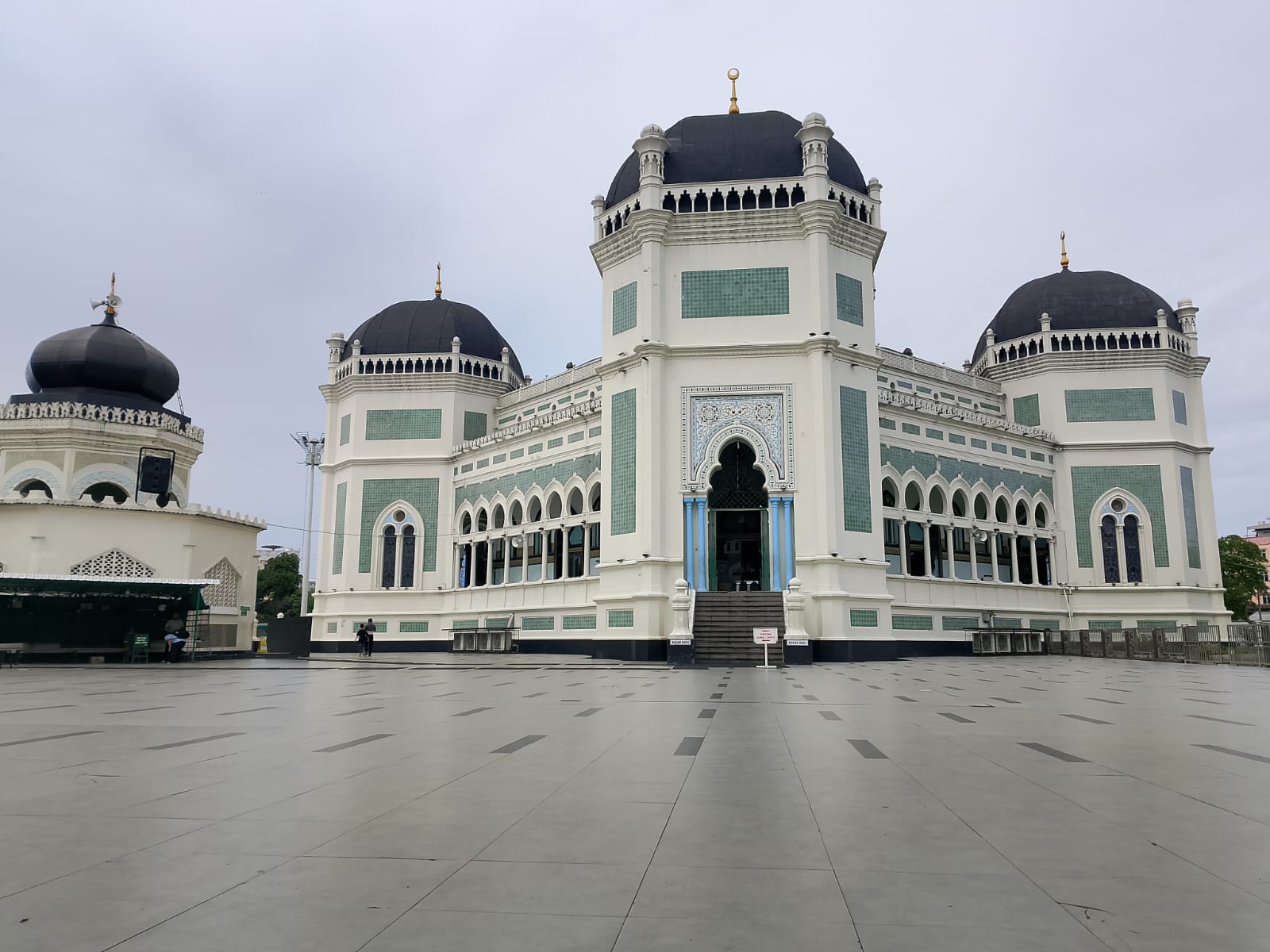
Moorish/Middle Eastern: Seen in the octagonal shape and the massive black domes.
Indian (Mughal): The pointed arches and decorative minarets.
Spanish/Italian: The stained glass windows and high-quality marble.
3. The "Octagon" and Its Interior
Unlike many mosques that are square, Al-Mashun is octagonal (eight-sided). This unique shape allowed for a symmetrical design with four main wings acting as entrances.
Premium Materials: The Sultan spared no expense. The marble was imported from Italy, the stained glass from Germany, and the chandeliers from France.
The Black Domes: The five dark-colored domes are a striking contrast to the white and yellow (the color of Malay royalty) walls.
4. A Witness to History
The mosque has stood for over 115 years. It has witnessed:
The transition from the Deli Sultanate to the Republic of Indonesia.
The colonial era and the Japanese occupation.
The modernization of Medan, yet the mosque itself has never been significantly altered, preserving its original 1909 aesthetic.
The Great Mosque of Medan remains a symbol of the "Land of Deli" and a testament to the Sultan's dream of creating a masterpiece that blends Malay identity with global artistry
The Mosque was commissioned by Sultan Ma'mun Al-Rashid Perkasa Alamsyah, the 9th ruler of the Deli Sultanate. At the height of the tobacco boom in the late 19th and early 20th centuries, the Sultanate was incredibly wealthy.
The Sultan wanted to build a mosque that was even more magnificent than his own palace (Maimun Palace), believing that God's house should take precedence over his own. Construction began on August 21, 1906, and was completed in 1909.
2. The Architect: Theodorus van Erp
While many colonial buildings in Indonesia were designed by Dutch architects, this mosque has a very special connection. It was initially designed by Theodorus van Erp, a Dutch architect who is most famous for leading the major restoration of the Borobudur Temple.
However, because Van Erp was called to Central Java for the Borobudur project, the completion of the mosque was handed over to another Dutch architect, J.A. Tingdeman.
A Global Architectural "Fusion"
The Sultan requested a design that reflected the international status of Medan at the time. The architects combined several styles:
Moorish/Middle Eastern: Seen in the octagonal shape and the massive black domes.
Indian (Mughal): The pointed arches and decorative minarets.
Spanish/Italian: The stained glass windows and high-quality marble.
3. The "Octagon" and Its Interior
Unlike many mosques that are square, Al-Mashun is octagonal (eight-sided). This unique shape allowed for a symmetrical design with four main wings acting as entrances.
Premium Materials: The Sultan spared no expense. The marble was imported from Italy, the stained glass from Germany, and the chandeliers from France.
The Black Domes: The five dark-colored domes are a striking contrast to the white and yellow (the color of Malay royalty) walls.
4. A Witness to History
The mosque has stood for over 115 years. It has witnessed:
The transition from the Deli Sultanate to the Republic of Indonesia.
The colonial era and the Japanese occupation.
The modernization of Medan, yet the mosque itself has never been significantly altered, preserving its original 1909 aesthetic.
The Great Mosque of Medan remains a symbol of the "Land of Deli" and a testament to the Sultan's dream of creating a masterpiece that blends Malay identity with global artistry